Barry-Wehmiller team members have a new way to get ahead of one of manufacturing's fastest-growing tools. A four-course training series on Additive Manufacturing (AM), commonly known as 3D printing, is now available through BWU, with courses starting this month, March, and running through June of this year. The training is designed to help everyone across the enterprise understand when and how to use 3D printing to solve real problems: faster prototyping, lower part costs, and simpler sourcing. Read on for details on how to attend!
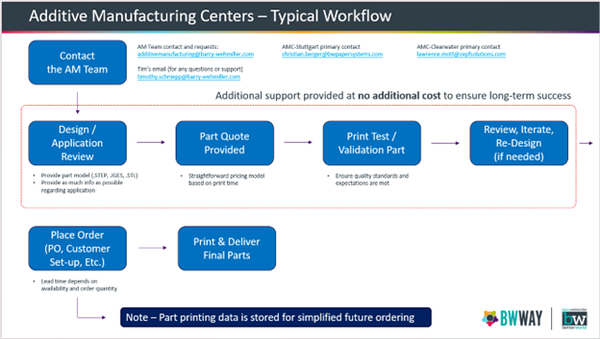
Meanwhile, the opportunity for AM is already proving itself for BW. Across our company, teams are using the two dedicated Additive Manufacturing Centers in Stuttgart, Germany, and Clearwater, Florida, to turn weeks-long sourcing challenges into days — and thousand-dollar parts into hundred-dollar ones.
Why Additive Manufacturing
Additive manufacturing allows teams to produce parts faster, often at significantly lower cost, while reducing reliance on external suppliers.
Typical benefits include:
Lower cost
- Many parts can be produced internally for 40–90% less than traditional manufacturing methods, depending on the design and materials used.
Faster delivery
- Parts that might take weeks or months to source externally can often be produced in days through additive manufacturing.
Simplified supply chains
- Parts can be printed closer to where they are needed, enabling a distributed manufacturing model that reduces supply chain risk and delays.
Design flexibility
- Complex geometries that are difficult, expensive, or nearly impossible with traditional machining or sheet metal fabrication can often be produced easily with additive manufacturing.
These advantages help engineering teams’ prototype faster, respond quickly to issues, and improve cost structure on production parts.
BW Use Case 1: Turning a $1,200 Part into a $200 Part
One part — a protective dust cover and saw blade guard — was originally fabricated as a multi-piece sheet metal assembly, carrying a $1,200 price tag and a 6–8 week wait.
Redesigned for additive manufacturing, the part now costs:
- Internal print cost: under $200
- Estimated annual demand: 20–30 parts
- Annual savings: approximately $20,000
BW Use Case 2: From Sourced Parts to Printed Parts
The Converting team identified an opportunity to reduce costs on thread-up pulleys used across tissue converting lines in both Lucca and Green Bay. The existing components were traditionally manufactured parts sourced through external suppliers, which resulted in higher costs and longer lead times.
The BWC team partnered with the Additive Manufacturing Center (AMC-Stuttgart) to adapt the components for in-house production. Using industrial 3D printing, the pulleys were produced internally and validated for production use. This approach allowed the team to maintain performance requirements while significantly reducing cost and improving supply flexibility.
Results
✔ 40–80% cost savings per part depending on size
✔ Initial order of 58 parts produced internally
✔ Over 110 hours of print production completed
✔ Estimated annual savings of ~$15,000
✔ Reduced reliance on external suppliers
✔ Simplified global sourcing – designed in Green Bay, printed in Stuttgart, installed in Lucca, Italy
This is just two of many examples where additive manufacturing significantly reduced both cost and lead time while simplifying the design.
Where Additive Manufacturing Fits Best
Additive manufacturing is not intended to replace every manufacturing method. Think of it as another (and very versatile) tool in your toolbox. It is most effective for specific types of parts.
Common applications include:
- Covers, guards, brackets, and air/vacuum ducts
- Complex shapes that are difficult to machine
- Prototype parts for testing and validation
- Jigs, fixtures, and manufacturing tools
- Replacement parts that are difficult to source
- Low-volume production parts (10s to 100s of parts/year)
In some cases, additive manufacturing can also support legacy machines where suppliers no longer produce certain components, helping extend equipment life.
Training Now Available Across BW!
To help teams understand when and how to use additive manufacturing, the AM team has developed a series of training courses available through the BWU learning system.
These courses are designed to help participants:
- Understand the industrial capabilities of additive manufacturing
- Identify applications where AM provides value
- Learn how to design parts for 3D printing
Course 1… Why Additive Manufacturing – An Introduction
Date – March 25, 2026, 10 AM Central time